Erasmus+ · i-LEARN-TECH Initiative

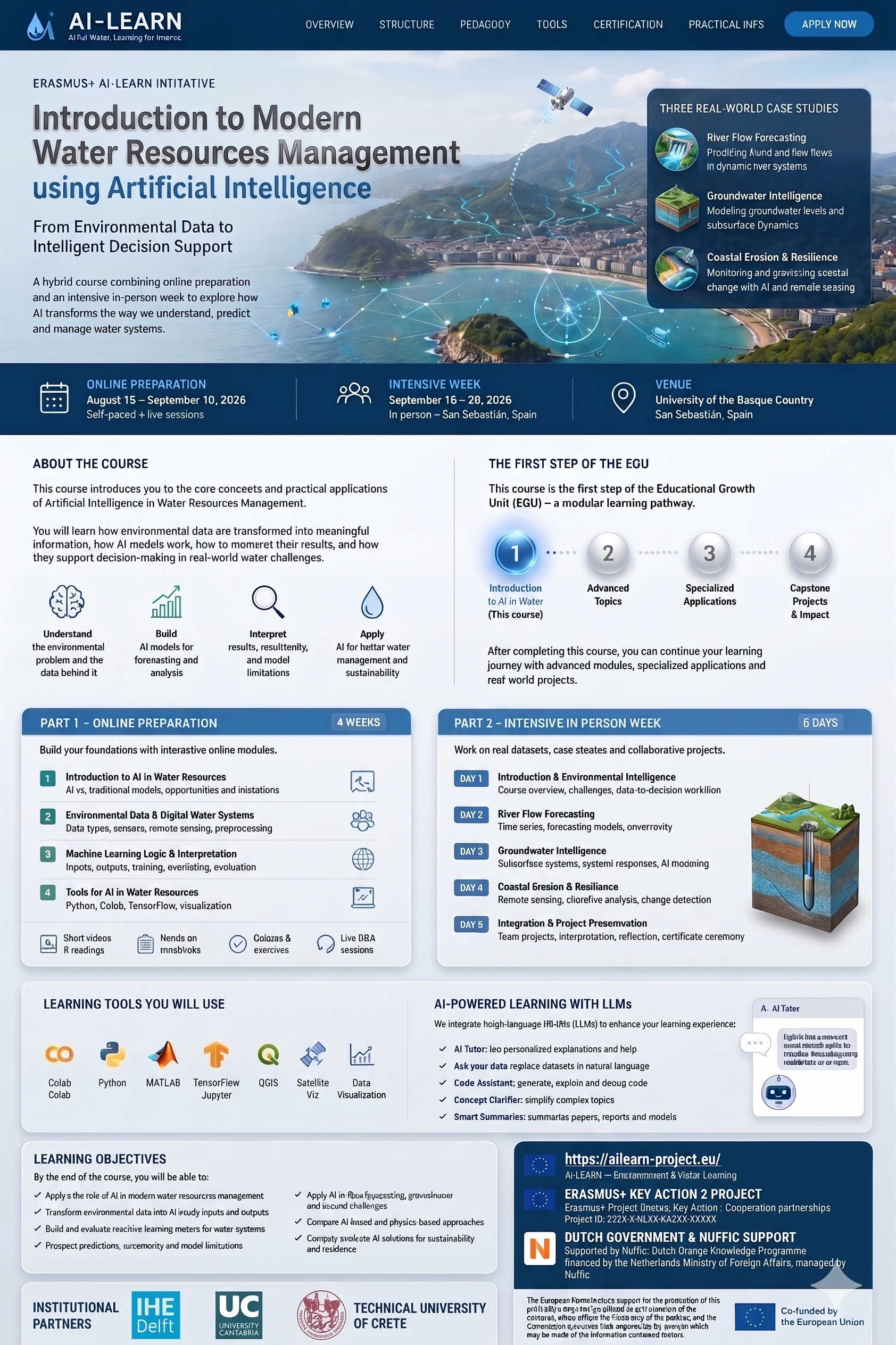
Introduction to Modern Water Resources Management using AI

From Environmental Data to Intelligent Decision Support.
Hosted by the University of the Basque Country (UPV/EHU) · San Sebastián, Spain

Part 1 — Online Preparation

August 2026

Every Friday · Open Enrolment

Part 2 — Intensive Week

Sept 14 – 18, 2026

San Sebastián · Limited Places

Venue

UPV/EHU

San Sebastián, Spain

Course Philosophy

The AI-LEARN initiative moves beyond the traditional "code-first" approach. This course follows a systems-thinking pedagogy: starting with the environmental challenge, understanding the physical meaning of data, and using Machine Learning to interpret complex water dynamics.

EGU Alignment & Modern Tools

We align with the European Geosciences Union (EGU) mission of advancing geosciences for a sustainable future. The training incorporates LLM-assisted learning, where Large Language Models act as tutors to help non-programmers bridge the gap between hydrological theory and Python implementation.

How to Participate

The course has two complementary parts. You may join Part 1 freely; Part 2 requires an application.

1

Part 1 — Online Preparation

Theory-first modules covering the foundations of AI in water resources. One live session every Friday throughout August 2026. Self-paced reading and exercises between sessions.

Open Enrolment — Unlimited Places
  • Free for all registered participants
  • Weekly live sessions every Friday in August
  • Self-paced reading and Python exercises
  • Certificate of completion for online part
2

Part 2 — Intensive In-Person Week

Hands-on lab work, real case studies and collaborative projects at UPV/EHU in San Sebastián. September 14 – 18, 2026.

Limited Places — Application Required
  • Selection based on professional background
  • Priority to applicants with high regional impact potential
  • Completion of Part 1 strongly recommended
  • Joint certificate from all partner institutions

Learning Pathway

The course follows a deliberate progression — from classical statistical thinking to modern deep learning — so that by the time you arrive at the in-person week, the focus is entirely on applying algorithms and interpreting results rather than learning syntax from scratch.

W1

Regression & Data

Linear models, time series, feature engineering from environmental sensors

W2

Clustering & Patterns

Unsupervised learning, grouping hydrological regimes, anomaly detection

W3

Classification

Decision trees, random forests, model evaluation and uncertainty quantification

W4

Deep Learning

Neural networks, LSTM for river/groundwater forecasting, intro to CNNs for coastal imagery

Apply

Run full ML pipelines on real data · Interpret predictions · Collaborative case studies

Online Preparation Modules

August 2026 · One live Friday session per week · Open to all

1

Introduction to AI in Water Resources

Overview of how AI differs from traditional models. Environmental problem framing, data-to-decision workflow, and basic linear regression as your first hands-on model. Python and Google Colab setup.

Linear Regression Python Setup Problem Framing
📄 Module materials (coming soon)
2

Environmental Data & Digital Water Systems

Types of environmental sensors, remote sensing data, and pre-processing pipelines. Exploratory data analysis and clustering methods to identify patterns in hydrological regimes.

Clustering EDA Remote Sensing
📄 Module materials (coming soon)
3

Machine Learning Logic & Interpretation

Supervised classification methods: decision trees, random forests, and support vector machines applied to water quality and flood risk. How models learn, overfit, and generalise. Evaluation metrics and uncertainty.

Classification Random Forest Model Evaluation
📄 Module materials (coming soon)
4

Tools for AI in Water Resources

Introduction to deep learning: fully-connected networks, LSTM for time-series forecasting, and a first look at CNNs for image-based coastal monitoring. Hands-on with Python, TensorFlow, Jupyter, QGIS and MATLAB.

LSTM TensorFlow MATLAB Deep Learning
📄 Module materials (coming soon)

The Three Pillars of Applied AI

1

River Flow Forecasting

Understanding rainfall-runoff relationships through neural networks. Focus on flood lead-times and uncertainty quantification.

2

Groundwater Modeling

Predicting subsurface water levels. Analyzing delayed responses and inferring hidden dynamics from sparse monitoring networks.

3

Coastal Dynamics

Addressing coastal erosion using satellite imagery and computer vision. Modeling shoreline resilience under climate change.

About the Course

This course introduces you to the core concepts and practical applications of Artificial Intelligence in Water Resources Management. You will learn how environmental data are transformed into meaningful information, how AI models work, how to interpret their results, and how they support decision-making in real-world water challenges.

The course covers three real-world case studies: river flow forecasting, groundwater intelligence, and coastal erosion and resilience. It emphasises understanding the environmental problem first, then using AI to build solutions.

AI-LEARN Course participants, San Sebastián 2026

Academic Calendar: Intensive Week

September 14 – 18, 2026 · UPV/EHU · San Sebastián, Spain

Day Date Core Focus Learning Activity
Day 1 — Mon Sept 14 Environmental Intelligence System understanding & Data-to-Input transformation.
Day 2 — Tue Sept 15 Riverine Systems (Pillar 1) Building LSTM models for hydrograph prediction.
Day 3 — Wed Sept 16 Subsurface Insights (Pillar 2) Inferring groundwater trends using feature engineering.
Day 4 — Thu Sept 17 Coastal Erosion (Pillar 3) Remote sensing analysis for shoreline change detection.
Day 5 — Fri Sept 18 Integrated Decision Support LLM-supported final project presentations & Certification.

Course Instructors

GC

Gerald Corzo

IHE Delft — Water Education

Associate Professor, Hydroinformatics & AI

EV

Emmanouil Varouchakis

Technical University of Crete

Assistant Professor, Geostatistics & Groundwater

AK

Anna Kamińska-Chuchmała

University of the Basque Country (UPV/EHU)

Senior Researcher, AI & Environmental Data

KL

Kostas Leptokaropoulos

MathWorks

Geoscience Academic Manager, MATLAB

CP

Cristina Prieto Sierra

IHCantabria — University of Cantabria

Researcher, Coastal & Water Systems

Registration & More Information

Registration details and fees will be announced by the partner institutions. The online preparation module (August 2026) is free and open to all. The in-person week requires an application; selection is based on professional background and the potential impact the participant can have in applying these methods in their region.

Get in Touch

For questions about the course, content, or how to participate:

Gerald Corzo — Course Coordinator

g.corzo@un-ihe.org

Subject line: [AI-LEARN Enquiry - Your Name]

Joint certificate issued by UPV/EHU · UPB · TU Crete · IHE Delft

Erasmus+ Project i-LEARN-TECH · 2026

★★★
EU

Funded by

the European Union

Acknowledgement

The realization of the AI-LEARN (i-LEARN-TECH) project has been made possible by funding from the ERASMUS+ grant programme of the European Union (grant number: 2025-1-NL01-KA220-HED-000355215). We are deeply grateful for their invaluable support, which has enabled us to undertake this important endeavour. Their commitment to promoting educational initiatives and intercultural exchange has been instrumental in shaping the trajectory of our project and empowering us to make meaningful contributions to our field.

Views and opinions expressed are those of the authors only and do not necessarily reflect those of the European Union or the European Education and Culture Executive Agency (EACEA). Neither the European Union nor EACEA can be held responsible for them.