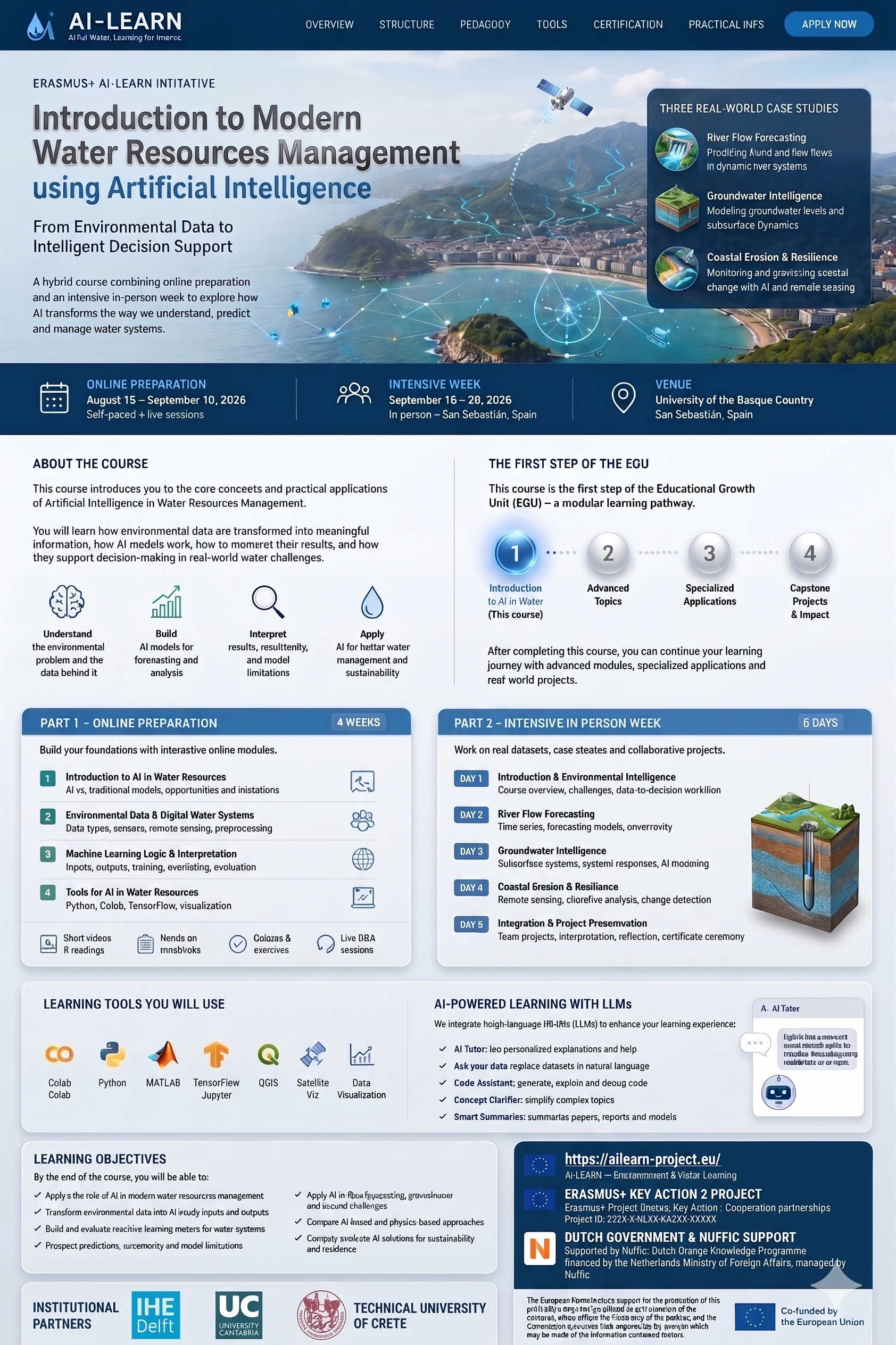
From Environmental Data to Intelligent Decision Support.
Fully Online · Live Sessions Every Friday in August 2026
Online Course
7 – 28 August 2026
Every Friday · Registered Participants Only
Format
Live Sessions + Self-Paced
English · Online Platform
Course language: English · Apply now →
Erasmus+ Partner Institutions
IHE Delft
University of the
Technical UniversityThe AI-LEARN initiative moves beyond the traditional "code-first" approach. This course follows a systems-thinking pedagogy: starting with the environmental challenge, understanding the physical meaning of data, and using Machine Learning to interpret complex water dynamics.
We align with the European Geosciences Union (EGU) mission of advancing geosciences for a sustainable future. The training incorporates LLM-assisted learning, where Large Language Models act as tutors to help non-programmers bridge the gap between hydrological theory and Python implementation.
Technology Support
Guest Lecturers
The course is delivered fully online through live weekly sessions and self-paced materials.
Theory-first modules covering the foundations of AI in water resources. Starts Thursday 7 August 2026, with one live session every Friday through August. Self-paced reading and exercises between sessions.
The course follows a deliberate progression — from classical statistical thinking to modern deep learning — so that by the final module, the focus is entirely on applying algorithms and interpreting results rather than learning syntax from scratch.
Linear models, time series, feature engineering from environmental sensors
Satellite sensors, STAC/COG/Zarr, hands-on Google Earth Engine workflows
Distributions, trend testing, spatial autocorrelation and semivariograms
Neural networks, LSTM for river/groundwater forecasting, intro to CNNs for coastal imagery
Run full ML pipelines on real data · Interpret predictions · Collaborative case studies
Starts Friday 7 August 2026 · One live Friday session per week · Platform access limited to registered participants
Friday, 7 August 2026
Overview of how AI differs from traditional models. Environmental problem framing, data-to-decision workflow, and basic linear regression as your first hands-on model. Python and Google Colab setup.
Friday, 14 August 2026
From satellite archives to AI-ready datasets without downloading a single file. Sensor types, the STAC / COG / Zarr open-data stack, and a hands-on Google Earth Engine workflow — search, cloud-mask and prepare Sentinel-2 imagery — through a water-quality case study of the Urumea estuary (San Sebastián).
Friday, 21 August 2026
Measurement theory and uncertainty, descriptive statistics, and choosing probability distributions that fit hydrological physics. Trend testing (Mann–Kendall) and geostatistics — spatial autocorrelation, semivariograms, and space-time variability across well networks and satellite pixel stacks.
Friday, 28 August 2026
Introduction to deep learning: fully-connected networks, LSTM for time-series forecasting, and a first look at CNNs for image-based coastal monitoring. Hands-on with Python, TensorFlow, Jupyter, QGIS and MATLAB. Also lays the groundwork — gradients, sensitivity and model calibration — for the guest webinar on differentiable hydrologic modeling.
Understanding rainfall-runoff relationships through neural networks. Focus on flood lead-times and uncertainty quantification.
Predicting subsurface water levels. Analyzing delayed responses and inferring hidden dynamics from sparse monitoring networks.
Addressing coastal erosion using satellite imagery and computer vision. Modeling shoreline resilience under climate change.
This course introduces you to the core concepts and practical applications of Artificial Intelligence in Water Resources Management. You will learn how environmental data are transformed into meaningful information, how AI models work, how to interpret their results, and how they support decision-making in real-world water challenges.
The course covers three real-world case studies: river flow forecasting, groundwater intelligence, and coastal erosion and resilience. It emphasises understanding the environmental problem first, then using AI to build solutions.
University of the Basque Country (UPV/EHU)
Senior Researcher, AI & Environmental Data
IHCantabria — University of Cantabria
Researcher, Coastal & Water Systems
University of California, Irvine
Professor · SAGE, DREAM & AMALGAM
Most differentiable hydrologic modeling relies on automatic differentiation or costly numerical approximations that struggle to scale to large-sample and continental-scale applications. This webinar introduces SAGE (Sensitivity-Aware Gradient Estimation), a framework that combines process-based environmental models with exact analytic sensitivities — propagated alongside model states — to enable efficient gradient-based calibration, uncertainty quantification, sensitivity analysis, and machine learning integration, while retaining the interpretability of traditional hydrologic models.
The talk covers SAGE's theoretical foundations, its implementation in the SAGE-GUI software environment, and applications from conceptual rainfall-runoff models to large-sample hydrology — closing with a discussion of differentiable environmental modeling's role in bridging machine learning, process understanding, and scientific discovery.
Speaker
Jasper A. Vrugt — Professor, University of California, Irvine
Prof. Vrugt develops theory-guided approaches for Earth system science at the intersection of mathematics, statistics, physics and computation, with a primary focus on hydrology and land-surface processes. He leads the development of SAGE and has authored more than 150 peer-reviewed publications and widely used methods including DREAM and AMALGAM. He is a Fellow of AGU, GSA and SSSA, and a recipient of the AGU James B. Macelwane Medal and the GSA Donath Medal.
The course (August 2026) is free for registered participants. All sessions are delivered online through live weekly meetings and self-paced materials.
Apply / Register →Scan with your phone camera
Also available for questions
Subject line: [AI-LEARN Enquiry — Your Name]
Joint certificate issued by UPV/EHU · TU Crete · IHE Delft
Erasmus+ Project i-LEARN-TECH · 2026
Funded by
the European Union
The realization of the AI-LEARN (i-LEARN-TECH) project has been made possible by funding from the ERASMUS+ grant programme of the European Union (grant number: 2025-1-NL01-KA220-HED-000355215). We are deeply grateful for their invaluable support, which has enabled us to undertake this important endeavour. Their commitment to promoting educational initiatives and intercultural exchange has been instrumental in shaping the trajectory of our project and empowering us to make meaningful contributions to our field.
This course is one part of the wider Ai-LEARN project ↗ — explore the full programme, partner institutions, and other tools.
Views and opinions expressed are those of the authors only and do not necessarily reflect those of the European Union or the European Education and Culture Executive Agency (EACEA). Neither the European Union nor EACEA can be held responsible for them.